Disclosure: InsightfulPipe publishes this and is one of the servers compared.
The short answer
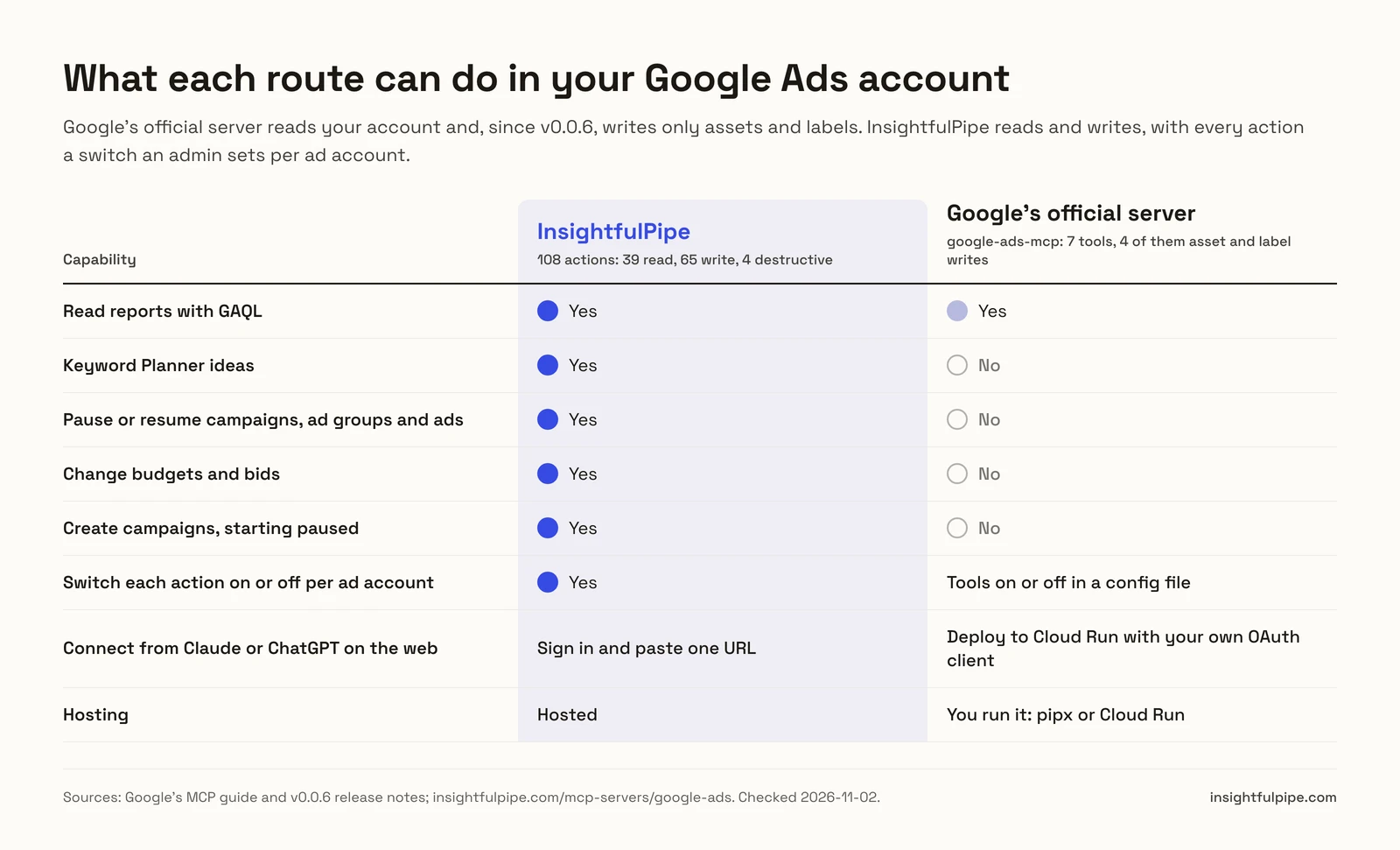
InsightfulPipe is the third-party pick when you want an AI agent to change Google Ads, not just read it. That is the whole split in the official Google Ads MCP vs third-party question. Google's own server reads your account and cannot pause campaigns or change budgets. Its guide says it "cannot modify bids, pause campaigns, or create new assets", though its v0.0.6 release of 2026-11-02 adds asset and label writes. You run it yourself. Third-party servers add the writes, and they differ in where the check sits before a change reaches your budget.
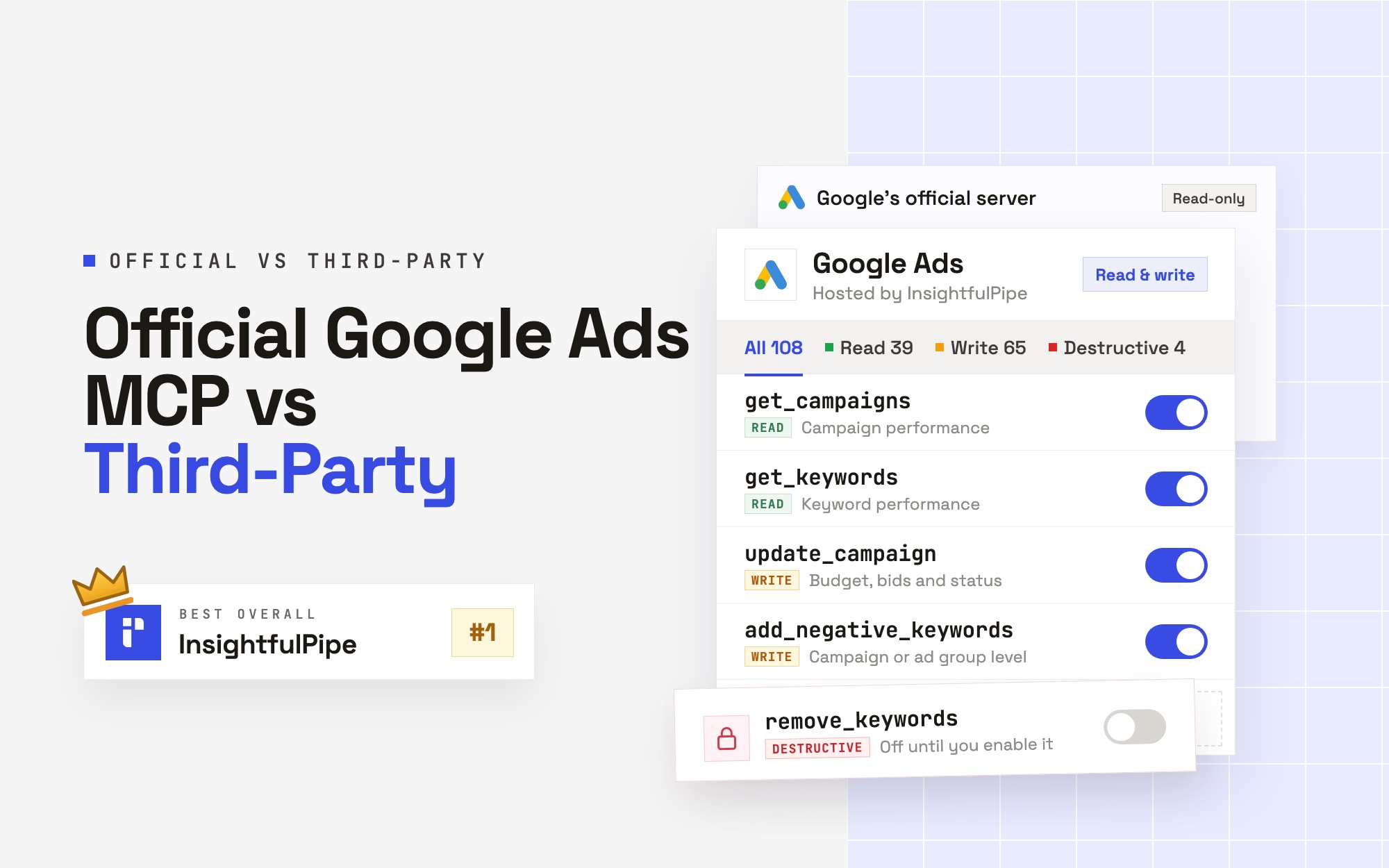
The InsightfulPipe Google Ads MCP server gives an agent 108 Google Ads actions: 39 read, 65 write and 4 destructive. An admin switches each one on or off per ad account, and the destructive ones stay off until an admin switches them on. That makes it the safest of the servers that can write. It runs hosted, works in Claude, ChatGPT, Cursor and Claude Code, and costs from $29.99 a month.
- Best overall: InsightfulPipe. 108 Google Ads actions, each one on or off per ad account, plus 49 more platforms on the same sign-in.
- Safest write access: InsightfulPipe. The server enforces your limits in every AI client, new campaigns start paused, and the assistant is told to ask before anything goes live.
- Best value for write access: InsightfulPipe. From $29.99 a month for 8 connected accounts with unlimited tool calls. Markifact starts at $79 and Ryze AI at $89.
Official Google Ads MCP vs third-party servers at a glance
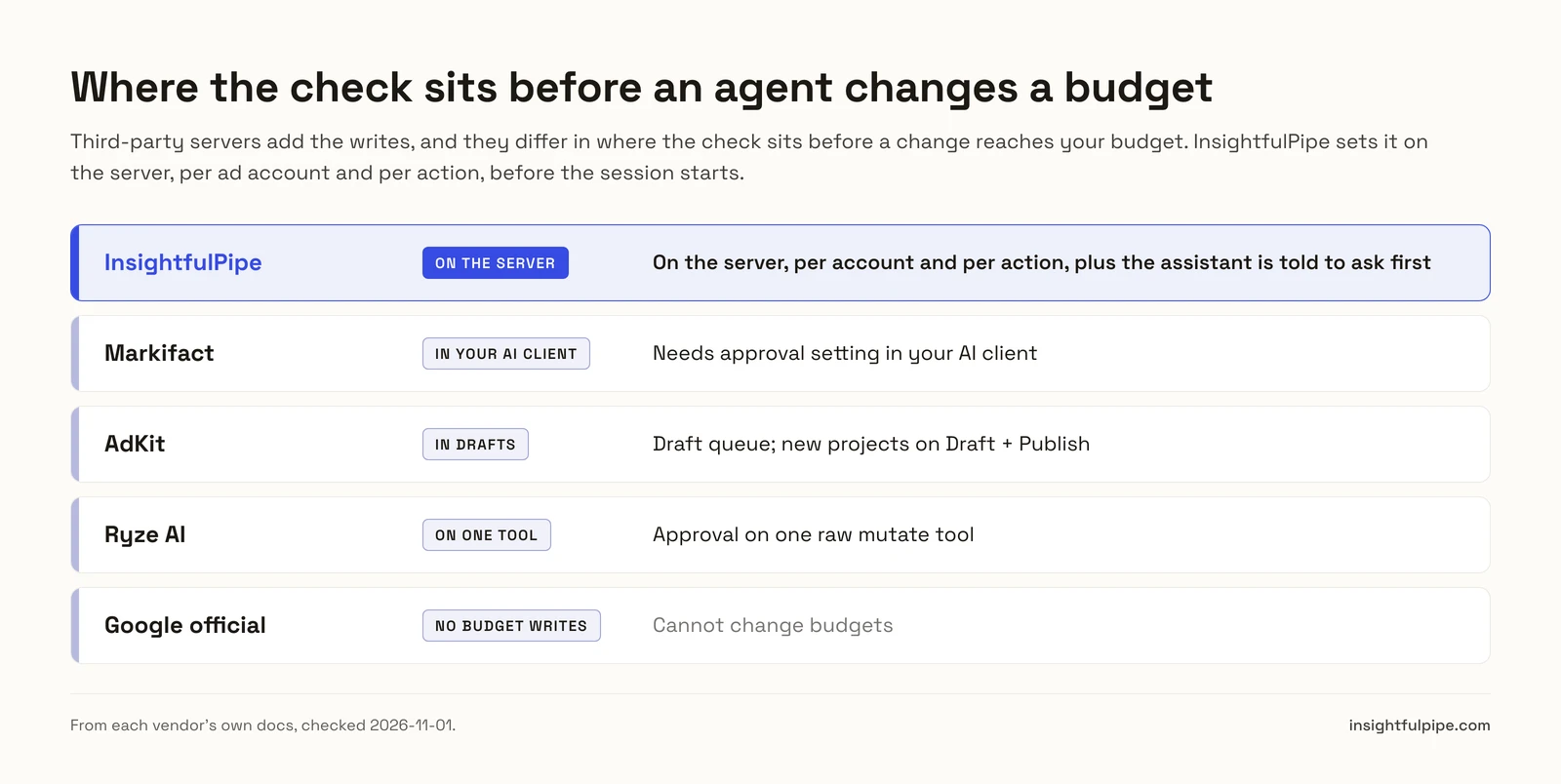
Google's server reads, plus assets and labels since v0.0.6; most third-party servers also change campaigns, and the gate before a write is what separates them. InsightfulPipe leads this table on control: a check per account and per action, set before the session starts.
Server | Hosting | Can it change Google Ads? | Check before a change | Starting price |
|---|---|---|---|---|
InsightfulPipe | Hosted | Yes: 108 actions, 65 write and 4 destructive | Only the actions an admin allows per account; destructive off until an admin switches them on | $29.99/mo |
Google official (google-ads-mcp) | You run it: pipx or Cloud Run | Assets and labels only: 3 read tools, 4 write tools since v0.0.6 | Propose and confirm on each write | Open source; you pay for hosting |
Markifact | Hosted | Yes: 60+ tools | Needs approval setting in your AI client | $79/mo |
AdKit | Hosted | Yes, as drafts | New projects start on Draft + Publish | $29/mo |
Adspirer | Hosted | Yes, staged | Stages each change for approval | $0 for 15 tasks, then $49/mo |
Pipeboard | Hosted | Yes: 35+ tools | New campaigns and ad groups start paused | $0 for 2 accounts, then $29.90/mo |
Ryze AI | Hosted | Yes: 14 tools, 6 write | Approval on each tool, including one raw mutate tool | $89/mo |
Synter | Hosted | Yes | "Approval controls" on writes | $20/mo |
Composio | Hosted SDK | Yes: 78 tools in its docs | None published | $0, then $29/mo |
Windsor.ai | Hosted | Yes: 34 write actions | Runs each write on request | $0, then $23/mo |
How we compared them
We read every capability, default and price from each vendor's own documentation, pricing page or public repository, and ran InsightfulPipe on live accounts. We checked everything on 2026-11-02, and weighted writes and control before a write highest, then setup, then price.
Criterion | What we checked |
|---|---|
Writes | Can the agent pause, rebudget, create and edit, or only read? |
Control before a write | Can an admin choose, per ad account, which actions the agent may use, and does the server enforce it? |
Default on a new connection | What can the agent do before anyone narrows it? |
Setup | A sign-in and one URL, or a Cloud project, an OAuth client and hosting? |
Price | What does write access cost to start, and is it metered? |
Where a vendor's pages contradict each other, we quote both. Where a capability is not published, we say so. Reporting pipelines such as Supermetrics, Funnel, Porter Metrics and Coupler.io have no card, because this comparison is about changing a Google Ads account. Neither does Scalekit, which sells a sign-in layer to developers building their own agent. The full ranking lives in the best Google Ads MCP servers.
Do you need the agent to report, or to act?
One question decides between the official server and a third-party one: does the agent only report, or does it also change the account? Reporting needs reads. Acting needs writes, and then the real question is what stands between the agent and your budget.
If it only reports, connect the account to InsightfulPipe as Read-only. Every write stays locked until an admin reconnects it with Read & write, and setup is a Google sign-in plus one URL. Google's server also reads, and it needs more: a Cloud project with an approved API access level, a machine to run it, and a Cloud Run deploy with your own OAuth client for web clients.
If it acts, Google's server drops out, because it cannot pause campaigns, change budgets or bids, or create campaigns. Among third-party servers, the gate decides. Markifact's approval is a setting in your AI client. AdKit holds changes in a draft queue. Ryze AI approves one raw mutate tool that covers most writes. InsightfulPipe sets the gate on the server, per ad account and per action, before the session starts.
Google's official Google Ads MCP server
Google's Ads API team publishes google-ads-mcp, an open-source server that reads your account and, since v0.0.6, creates assets and manages labels. It is narrower than most people expect.
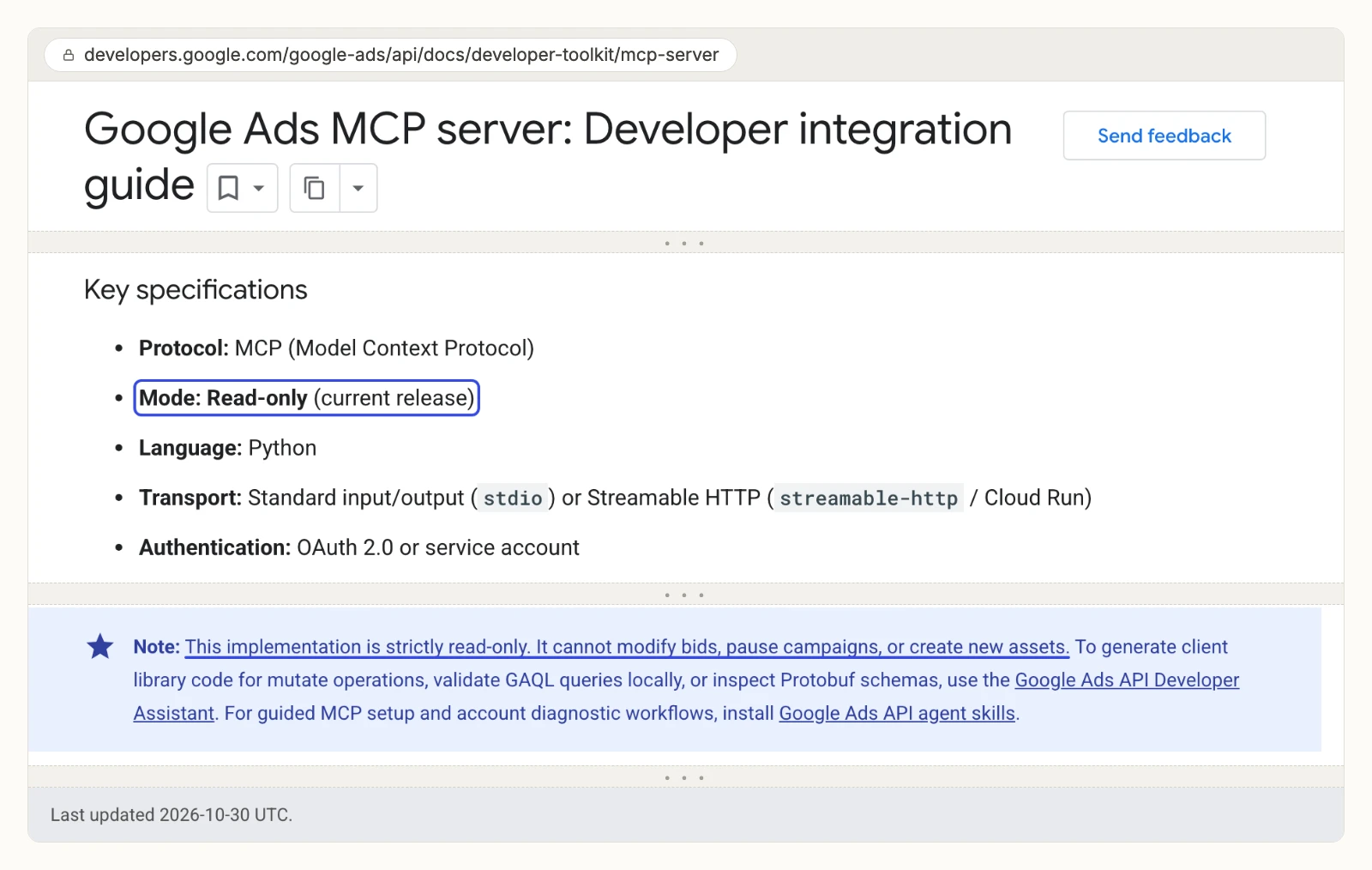
Google's guide, updated 2026-10-30, lists three tools: list_accessible_customers, search for GAQL reports, and get_resource_metadata. Its v0.0.6 release, published 2026-11-02, adds four write tools for assets and labels, each behind a propose-and-confirm step, while the guide still says read-only.
It runs on Python, locally over stdio or on Cloud Run over Streamable HTTP, with OAuth 2.0 or a service account. You need a Google Cloud project with Explorer, Basic or Standard API access. Developer tokens were sunset on September 9, 2026, so the latest version no longer needs one.
To reach it from Claude or ChatGPT on the web, you deploy it to Cloud Run with your own OAuth client and add the client's redirect URI. Google runs a hosted endpoint only as a pilot for allowlisted participants. The repository carries an Apache-2.0 license, lets you switch tools off in a config file, and adds a usage-data header to your API calls. For other writes, Google's guide points you to its Developer Assistant, which generates API code for you to run. MCP vs the API explains the difference.
Pros
- Maintained by the Google Ads API team.
- Runs on your own machine or Cloud project.
Cons
- No pausing, no budgets, no bids and no new campaigns; writes reach only assets and labels.
- Seven tools and no Keyword Planner.
- You host it, and web clients need Cloud Run plus your own OAuth client.
InsightfulPipe: third-party writes within limits you set
InsightfulPipe is a hosted MCP server that gives an AI agent 108 Google Ads actions, and you decide which of them each ad account allows. It is the pick when you want the assistant to do the work in Google Ads, not describe it.
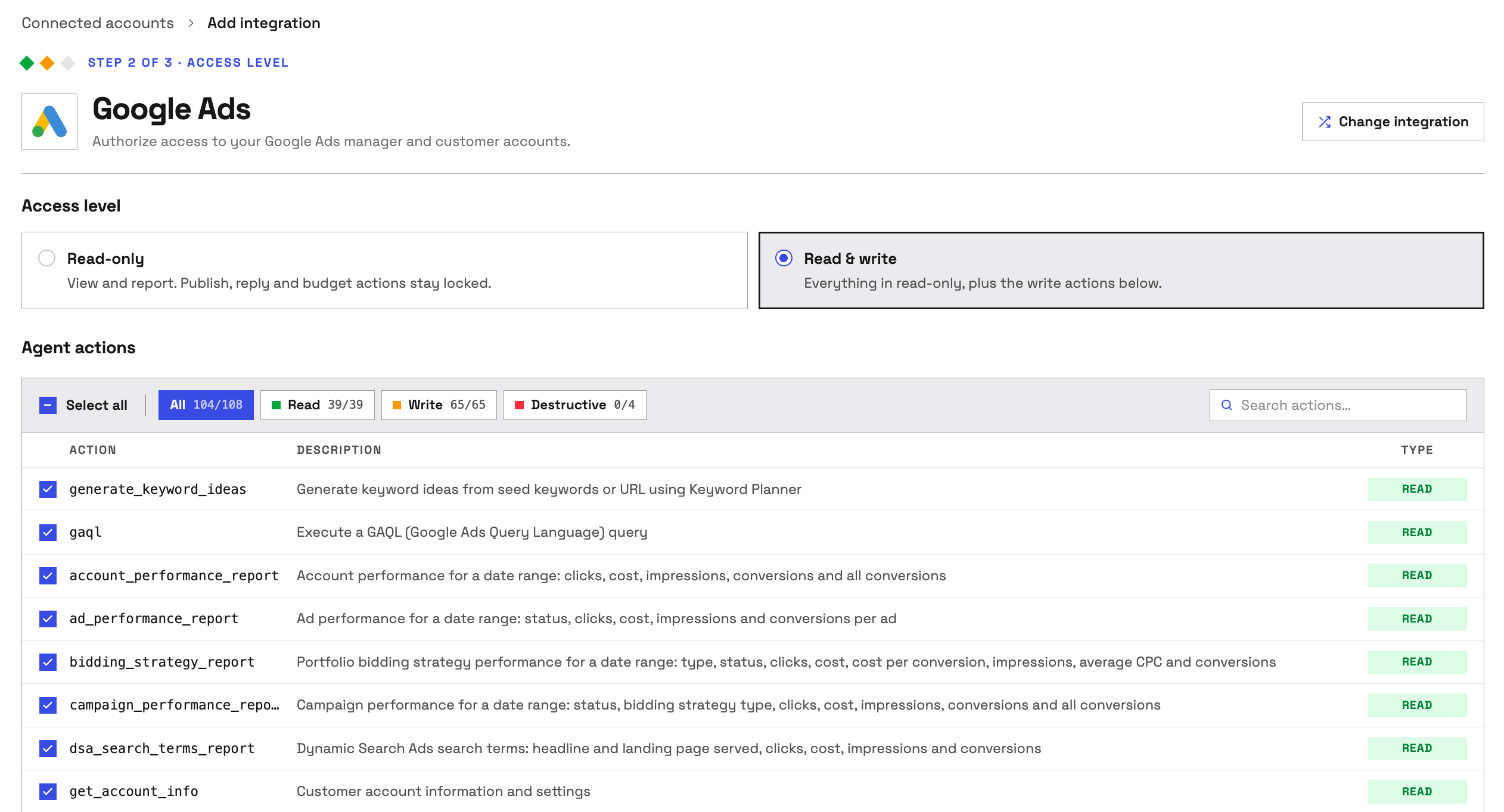
Coverage is the first difference. Google's server has seven tools, four of them for assets and labels. InsightfulPipe has 108, split into 39 read, 65 write and 4 destructive:
- Reporting and research: raw GAQL, ready-made account, campaign, ad, keyword, search term and bidding reports, change history, and Keyword Planner ideas
- Campaigns: Search, Display, Performance Max, Dynamic Search Ads and App campaigns each have their own create action, plus name, dates, budget, bid targets and status
- Ad groups, ads and keywords: create, update, pause and resume, with keyword bids and negative keywords
- Assets and Performance Max: sitelinks, callouts, call, price, structured snippet and lead form assets, images, YouTube videos, and asset groups with audience signals
- Targeting and bidding: locations, radius, demographics, audiences, device bid adjustments and portfolio bidding strategies
- Conversions and audiences: conversion actions, click conversion uploads and Customer Match lists
Why it is the safest way to let an agent write
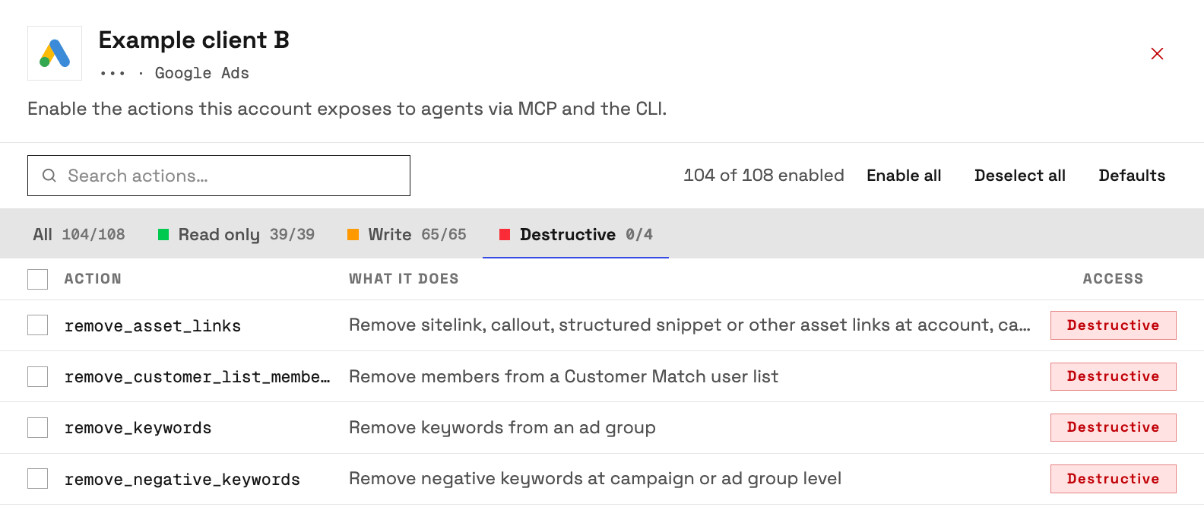
Control is the second difference. Every limit is a switch, and your admin decides where each one sits. An owner, admin or operator opens a connected account and picks the actions the agent can use, one by one. The server enforces that list, not your AI client, so the same limits hold in Claude, ChatGPT, Cursor, Claude Code and the CLI. The server refuses any action an admin has switched off, in every client.
- Destructive actions start off. Removing keywords, negative keywords, Customer Match members or asset links stays off until an admin switches it on.
- Read-only means read-only. A Read-only connection locks every write until an admin reconnects it with Read & write.
- New campaigns, ad groups and ads start paused, for you to set live when they are ready.
- The assistant is told to ask first. Before it sets anything live or removes it, the server tells it to get your explicit confirmation.
- Roles hold. Members on the user role can only view the accounts an admin grants them. Writes need an operator, admin or owner.
Google Ads has one OAuth scope for reading and changing. So a read-only promise from any third-party server is the server's promise, not Google's. InsightfulPipe keeps it on the server, account by account.
What else you get
- 50 platforms on one connection, including GA4, Search Console, Meta Ads and Microsoft Ads.
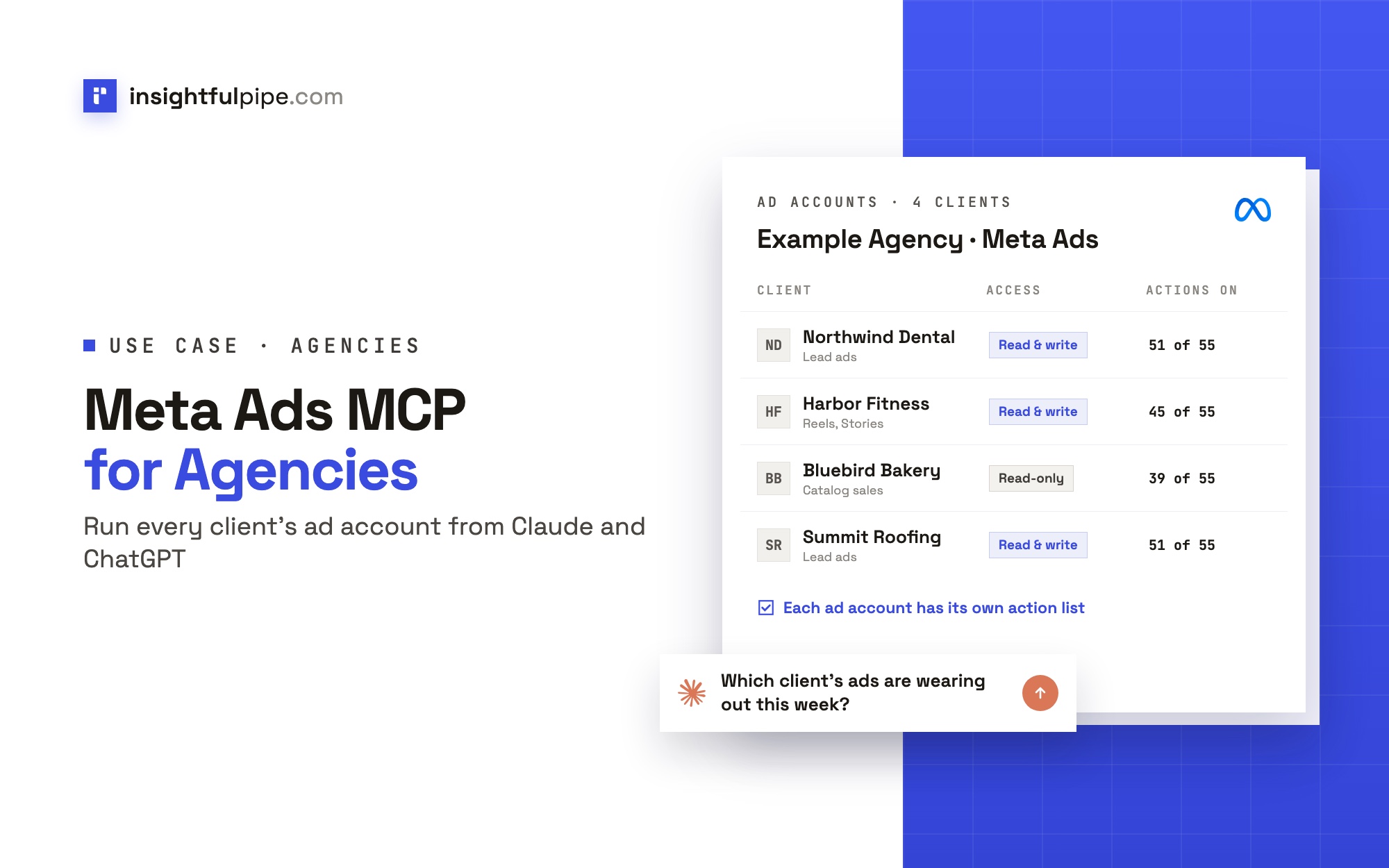
- Manager accounts: connect an MCC and its client accounts come in as separate connections, each with its own action list.
- Every major AI client: Claude and ChatGPT from their directories, plus Claude Code, Cursor, Gemini CLI and Codex CLI.
- A CLI: the InsightfulPipe CLI runs the same reads and writes from a terminal, under the same per-action controls.
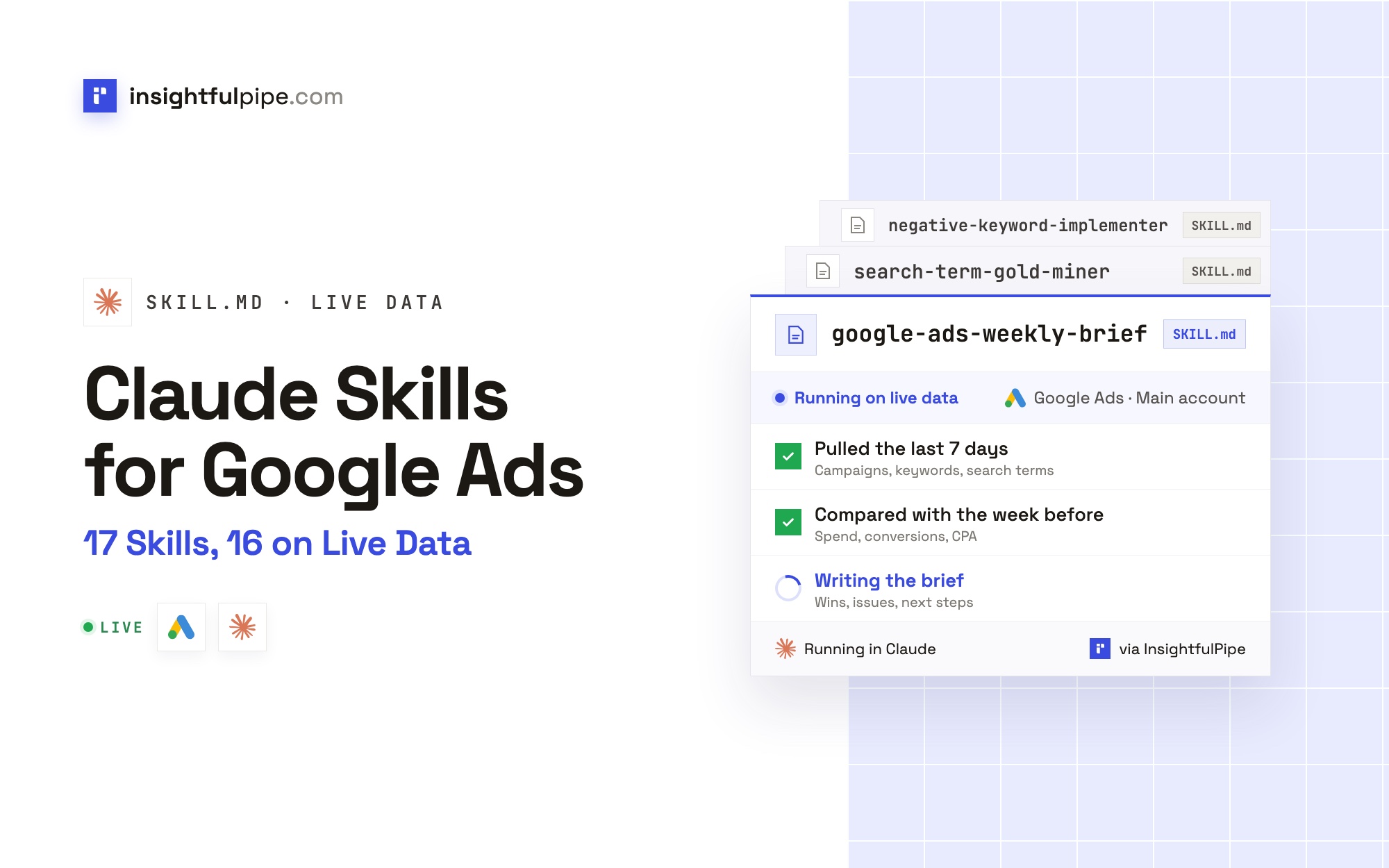
- Skills: Claude skills for Google Ads audits, pacing and search terms, built on this server.
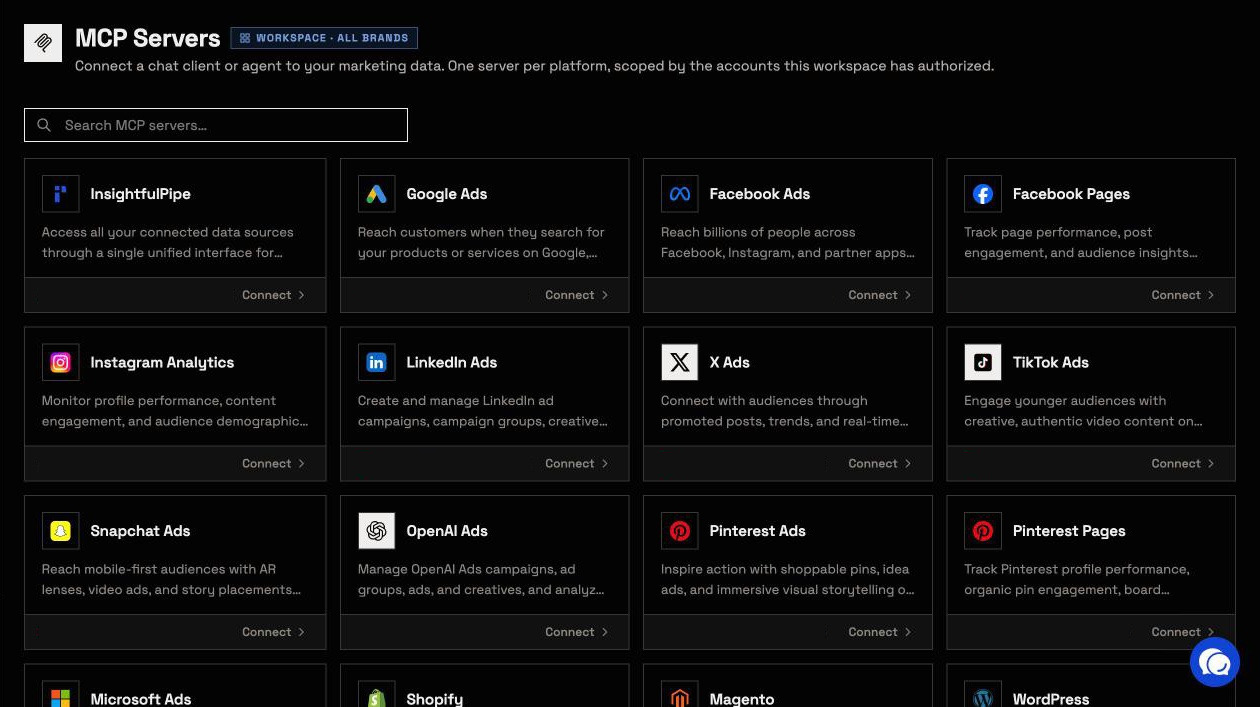
Pricing: from $29.99 a month, with every MCP server and the CLI on every plan. Start a trial and connect your first account.
Best for: agencies and in-house teams who want an agent that runs Google Ads within limits they set, account by account.
Other third-party Google Ads MCP servers
Eight more hosted servers can change Google Ads, and each puts its safety check in a different place. Here is what each one's own pages say.
Markifact
Markifact sells approval on every write, and its docs place that approval in your AI client.
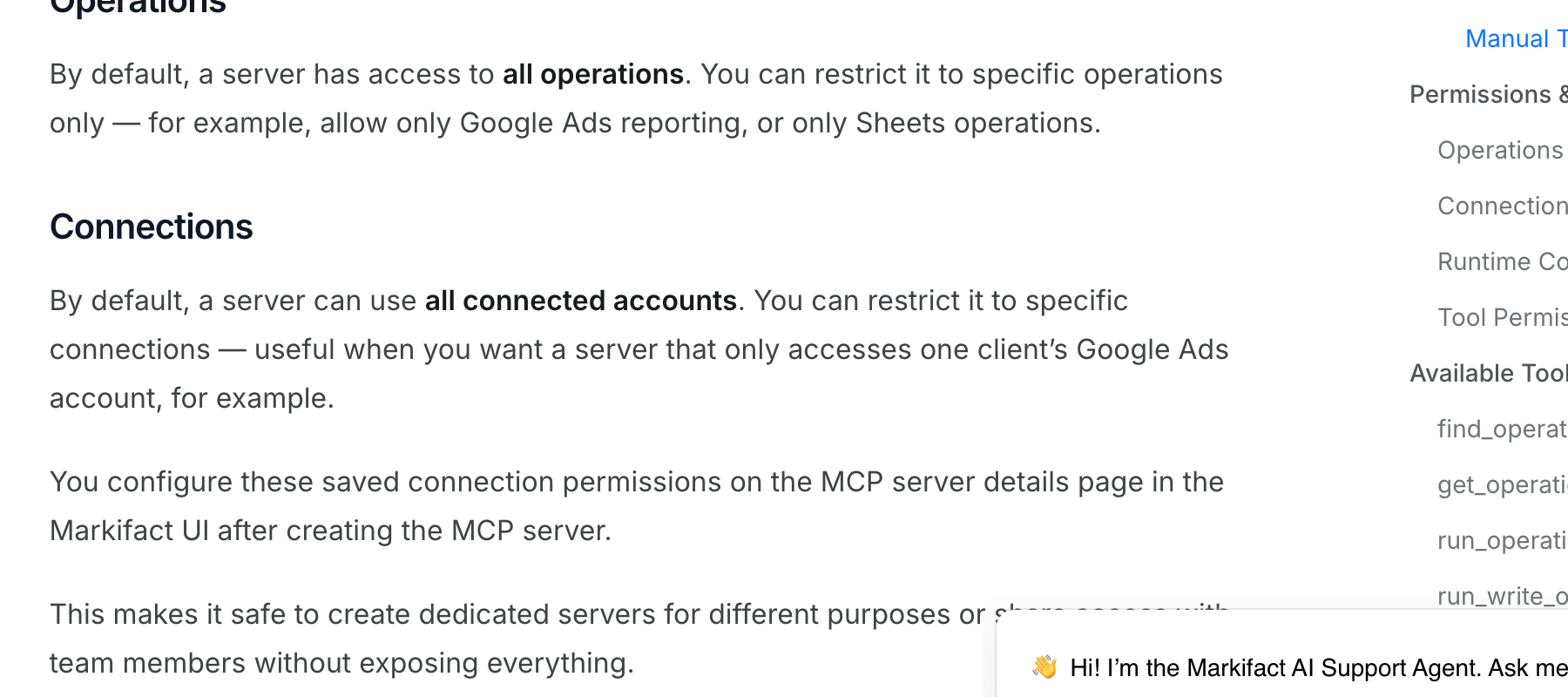
Its product page lists 60+ Google Ads tools and says "Every change waits for your approval before it goes live." Its MCP docs say a new server reaches all operations and all connected accounts, and the approval is the Needs approval setting in your client. See InsightfulPipe vs Markifact.
Cons
- A new server reaches every operation and account until you narrow it.
- The approval is your AI client's setting.
- From $79 a month, metered in credits.
AdKit
AdKit saves changes as drafts, and its docs say new projects can publish them.
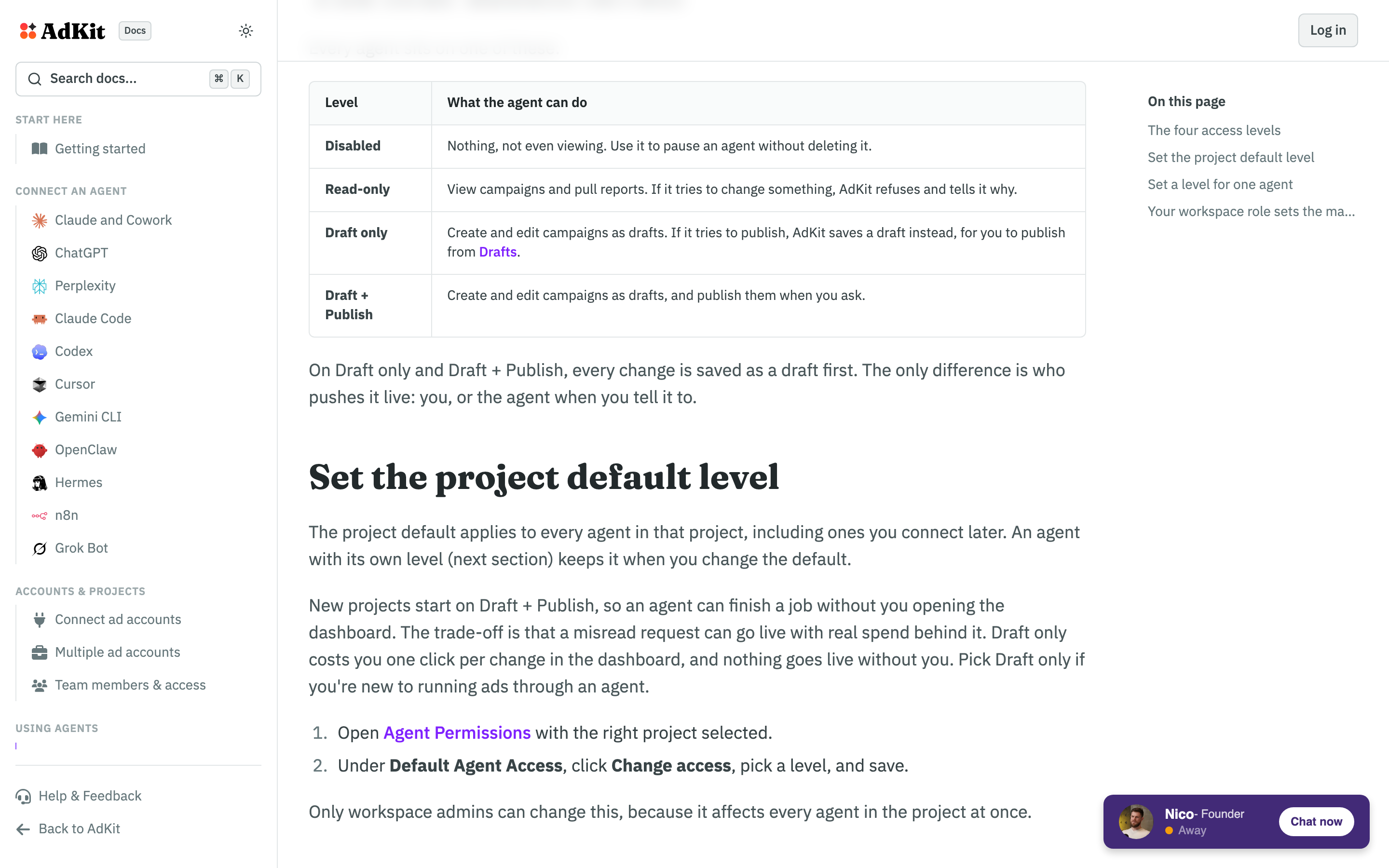
Its access levels run from Disabled through Read-only and Draft only to Draft + Publish. New projects start on Draft + Publish, and AdKit says plainly that "a misread request can go live with real spend behind it."
Cons
- New projects start on Draft + Publish.
- Four levels per project or agent, not action by action.
- The $29 plan connects one ad account per platform.
Adspirer
Adspirer stages each change for approval and prices by the task. Its post says new campaigns start paused and deletes need a confirm_delete flag. Its pricing gives 15 tasks a month at $0, then 150 for $49.
Cons
- Metered by task.
- Its post still says Google's server needs a developer token.
- The post says 15 tool calls; the pricing page says 15 tasks.
Pipeboard
Pipeboard lists 35+ Google Ads tools in its API reference, and new campaigns and ad groups start paused. Its pricing covers 2 ad accounts at $0, then 3 for US$29.90. See InsightfulPipe vs Pipeboard.
Cons
- No Keyword Planner tool in its API reference.
- Permission-scoped tokens start on Pro.
- Each extra ad account costs $10 a month.
Ryze AI
Ryze AI sells an AI marketer, and its MCP server writes through one raw tool. Its Google Ads MCP page lists 14 tools, 6 of them writes. One tool, runRawMutate, creates or updates campaigns, budgets, ad groups, ads and assets. See InsightfulPipe vs Ryze AI.
Cons
- Approving the raw mutate tool approves most writes at once.
- 14 Google Ads tools.
- From $89 a month.
Synter
Synter covers 16 ad platforms and says writes "go through approval controls". Its comparison post promises a "Free tier" with no card; its pricing page charges $20 at checkout, "card required".
Cons
- Its post and pricing page disagree on a free tier.
- Scale costs $500 a month per workspace.
- "Capability depth varies across the 16-platform catalog", in its words.
Composio
Composio is developer infrastructure. Its toolkit page and docs list 78 Google Ads tools, including one batch mutate tool that can create, update or remove resources in one request. See InsightfulPipe vs Composio.
Cons
- One batch mutate tool creates, updates or removes resources in one call.
- A developer token sits in its auth config.
- No approval step or paused default published.
Windsor.ai
Windsor.ai is a data pipeline first, with 34 Google Ads write actions on top. Its write actions page starts new campaigns paused, and the AI client "executes it on request". See InsightfulPipe vs Windsor.ai.
Cons
- No server-side approval published for writes.
- Plans go by data source: $23 a month covers 3.
- A new campaign cannot be undone by one action, per its FAQ.
Other servers that AI answers name
AI answers to this question also name these servers. Each row states what the server's own page or repository says.
Server | Type | Changes Google Ads? | What it needs or lacks |
|---|---|---|---|
NotFair | Hosted | Yes, with approval on writes | Growth plan $99/mo; its comparison still says Google's server expects a developer token |
Opus Growth | Hosted | Yes, previewed first | Caps a budget move at +50% a step and +100% in 24 hours |
Zapier MCP | Hosted | Campaign status, customer lists and offline conversions | No campaign, ad group, ad or budget edits |
Adzviser | Hosted | No | "No campaign edits, write-backs" |
FGRibreau/mcp-google-ads | Self-hosted | Yes: 63 tools, preview then confirm | Developer token, your own OAuth client, 69 GitHub stars |
get-mcp-ads | Self-hosted | 13 write tools, off by default | Developer token and local setup |
clientskatbi/google-ads-campaign-mcp | Self-hosted | Yes: status and budget tools | 0 stars; README warns the tools change your live account |
GoMarble (open source) | Self-hosted | No: 3 read tools | Developer token; Keyword Planner included |
cohnen/mcp-google-ads | Self-hosted | No: 5 read tools | No commit since 2025-10-16 |
Which Google Ads MCP server can pause campaigns and change budgets?
InsightfulPipe can. Pausing a campaign, an ad group or an ad and changing a campaign budget are separate actions, each one an admin switches on per account. Google's official server cannot do either: its guide says it cannot pause campaigns, and its only write tools, added in v0.0.6, handle assets and labels.
Job | InsightfulPipe action | Google's official server |
|---|---|---|
Pause, resume or set a campaign live | update_campaign (status) | No |
Pause or resume an ad group | pause_ad_group, resume_ad_group | No |
Pause or resume an ad | pause_ad, resume_ad | No |
Change a campaign budget | update_campaign (budget) | No |
Change bid targets or a bid strategy | update_campaign, update_bidding_strategy | No |
Change keyword bids or pause a keyword | update_keywords | No |
Adjust bids by device | set_device_bid_modifier | No |
Read budgets and pacing first | get_campaign_budgets, campaign_performance_report | Yes, through GAQL search |
Other servers pause and rebudget too, with the check in different places. Pipeboard has pause and update tools. Ryze AI runs both through its raw mutate tool. Markifact's budget tool waits on your client's approval setting. Zapier sets a campaign's status but not its budget. FGRibreau and clientskatbi ship status and budget tools you host with your own developer token.
To decide which budget to move first, see Google Ads budget pacing with an AI assistant.
Is it safe to let an AI agent change Google Ads?
Yes, when the limits sit on the server and start on the careful side. InsightfulPipe is the safest of the servers that can write, because every limit is a switch your admin controls. Actions go on or off per ad account. Destructive actions stay off until an admin switches them on. A Read-only connection locks every write until an admin reconnects it with Read & write.
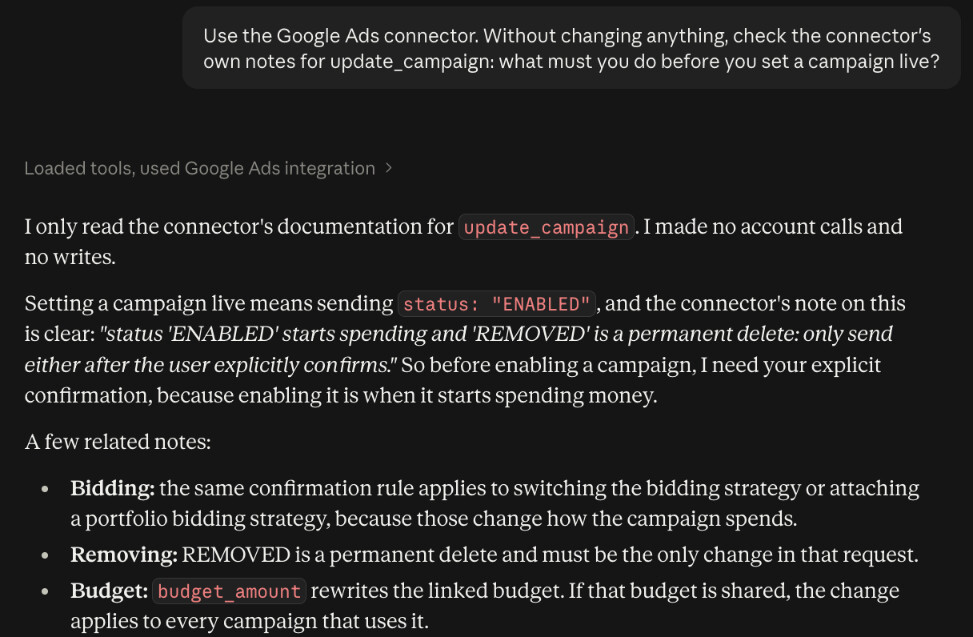
Two settings deserve a look before the first budget change. update_campaign covers status and budget, so the same action that pauses a campaign can also set it live or remove it. The server tells the assistant to get your explicit confirmation before either. Claude's Needs approval setting, under Customize > Connectors, is what holds the call until you click.
The server passes the budget you approve to Google as written. Read the amount in the approval before you allow it. On accounts where budgets should stay with a person, switch update_campaign off and keep pause_ad_group and pause_ad on. The agent can still stop spend at ad group and ad level.
Which should you choose?
Choose InsightfulPipe when you want an agent that reports and acts in Google Ads within limits you set, account by account.
- You want the agent to pause, rebudget and build campaigns: InsightfulPipe. 108 actions, each on or off per ad account, new campaigns paused, from $29.99 a month.
- You only need reports: a Read-only InsightfulPipe connection, which locks every write until an admin reconnects it with Read & write.
- You run an agency with a manager account: InsightfulPipe. Connect the MCC and give each client account its own action list.
- You report across Google Ads, GA4 and Search Console: InsightfulPipe, with 50 platforms on one sign-in.
- You build your own agent: the InsightfulPipe CLI, with the same per-action controls.
How to connect InsightfulPipe's Google Ads MCP server in four steps
Connecting takes a Google sign-in and one server URL, with no Cloud project and nothing to host. The full walkthrough is in how to connect Google Ads to Claude.
Step 1: Connect your Google Ads accounts
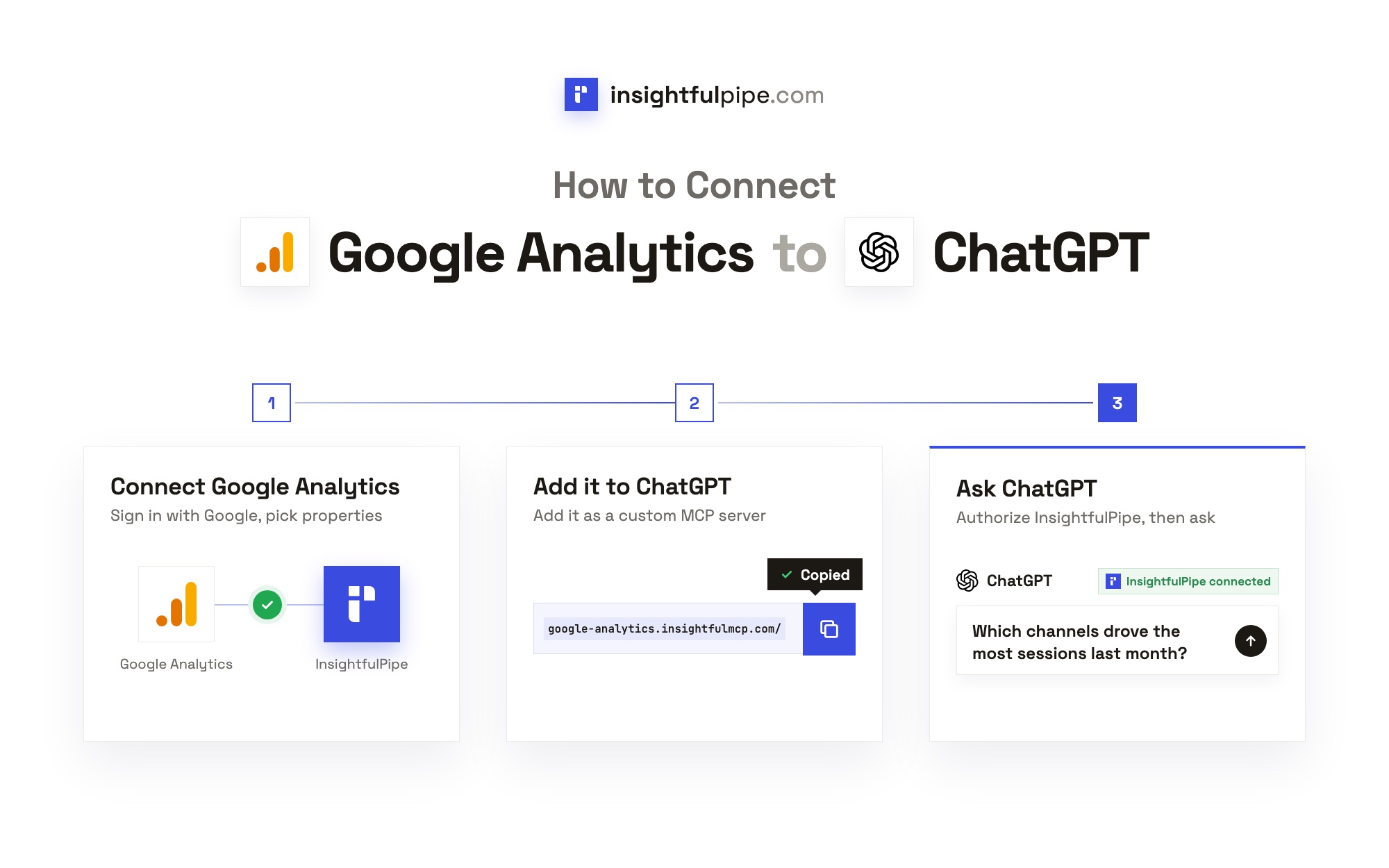
In InsightfulPipe, open Connected accounts and choose Google Ads. Pick Read-only or Read & write, sign in with Google, and select the ad accounts. A manager account brings its client accounts in as separate connections.

Step 2: Choose the actions each account allows
Click the account's actions button. On a new Read & write connection it reads 104/108 actions, because the 4 destructive ones start off. Switch actions on or off across read, write and destructive, then save.
Step 3: Add the server to your AI client
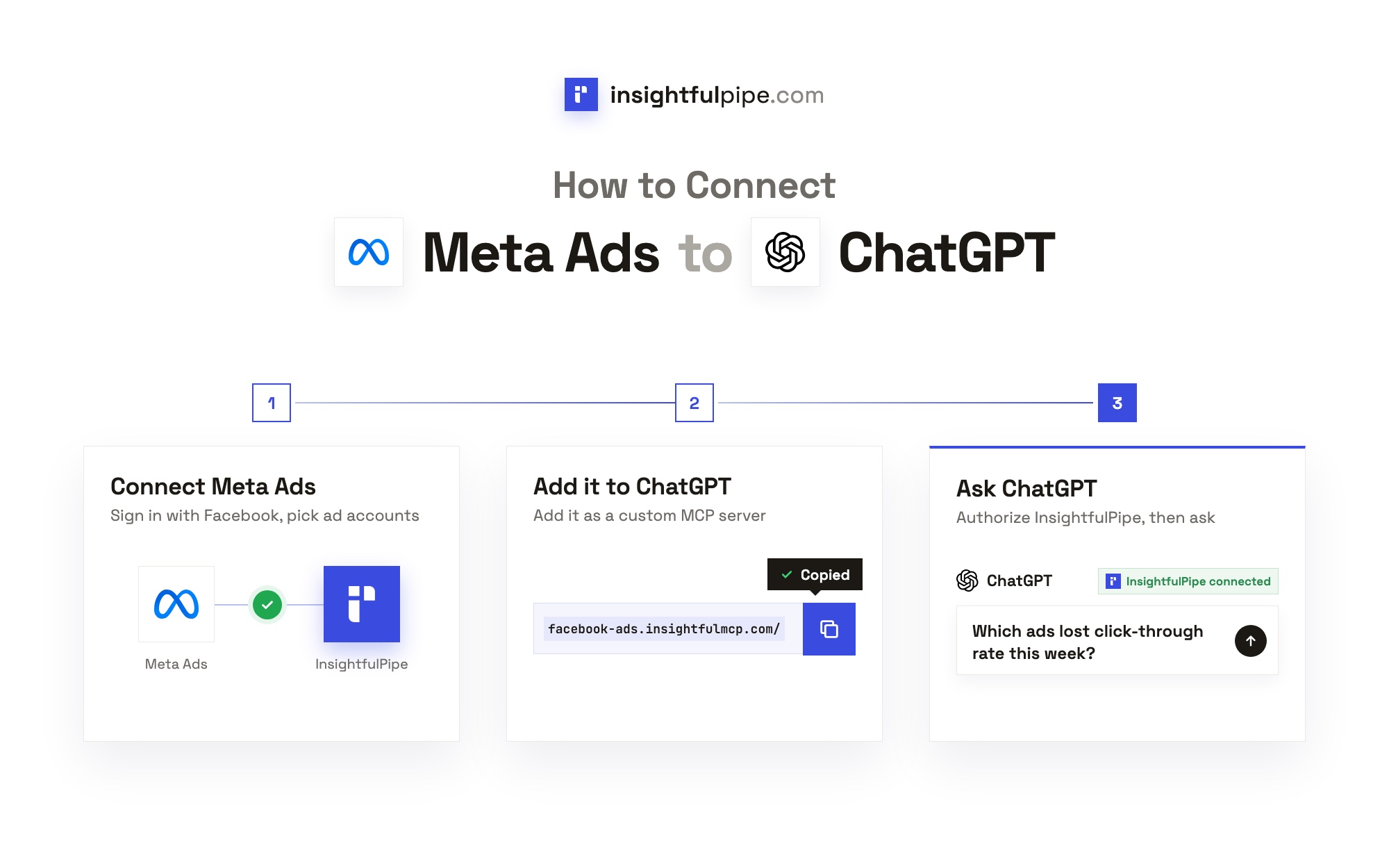
In Claude, add InsightfulPipe from the Claude Directory. Or open Customize > Connectors, click + Add, then Add custom connector, paste https://google-ads.insightfulmcp.com/, click Continue twice, then Add. Click Connect, sign in to InsightfulPipe if asked, then click Authorize access. In Claude Code, run claude mcp add --transport http google-ads-mcp https://google-ads.insightfulmcp.com/. ChatGPT, Cursor, Gemini CLI and Codex CLI finish with the same InsightfulPipe sign-in and Authorize access.
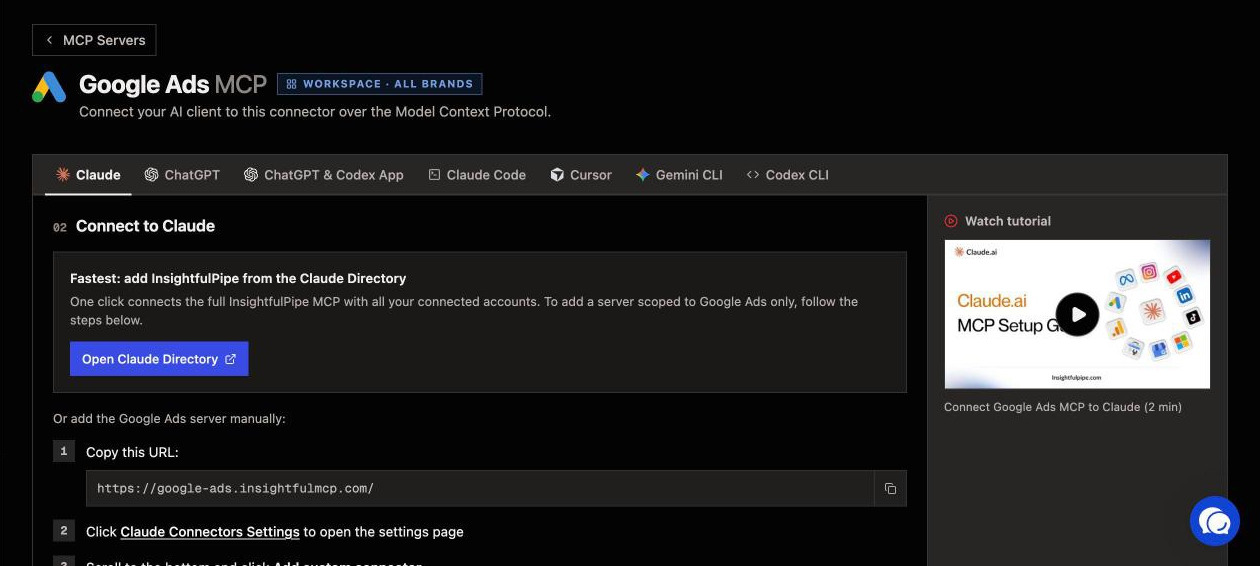
Step 4: Set approvals and ask your first question
In Claude, open Customize > Connectors, choose the connector, and set execute_action to Needs approval. Then start with a read, such as "Which campaigns spent the most last week with no conversions?" For more starting points, see 50 Google Ads prompts for Claude.
What the other vendors do not publish
Several pages that answer this question are out of date or disagree with themselves. Check these before you pay.
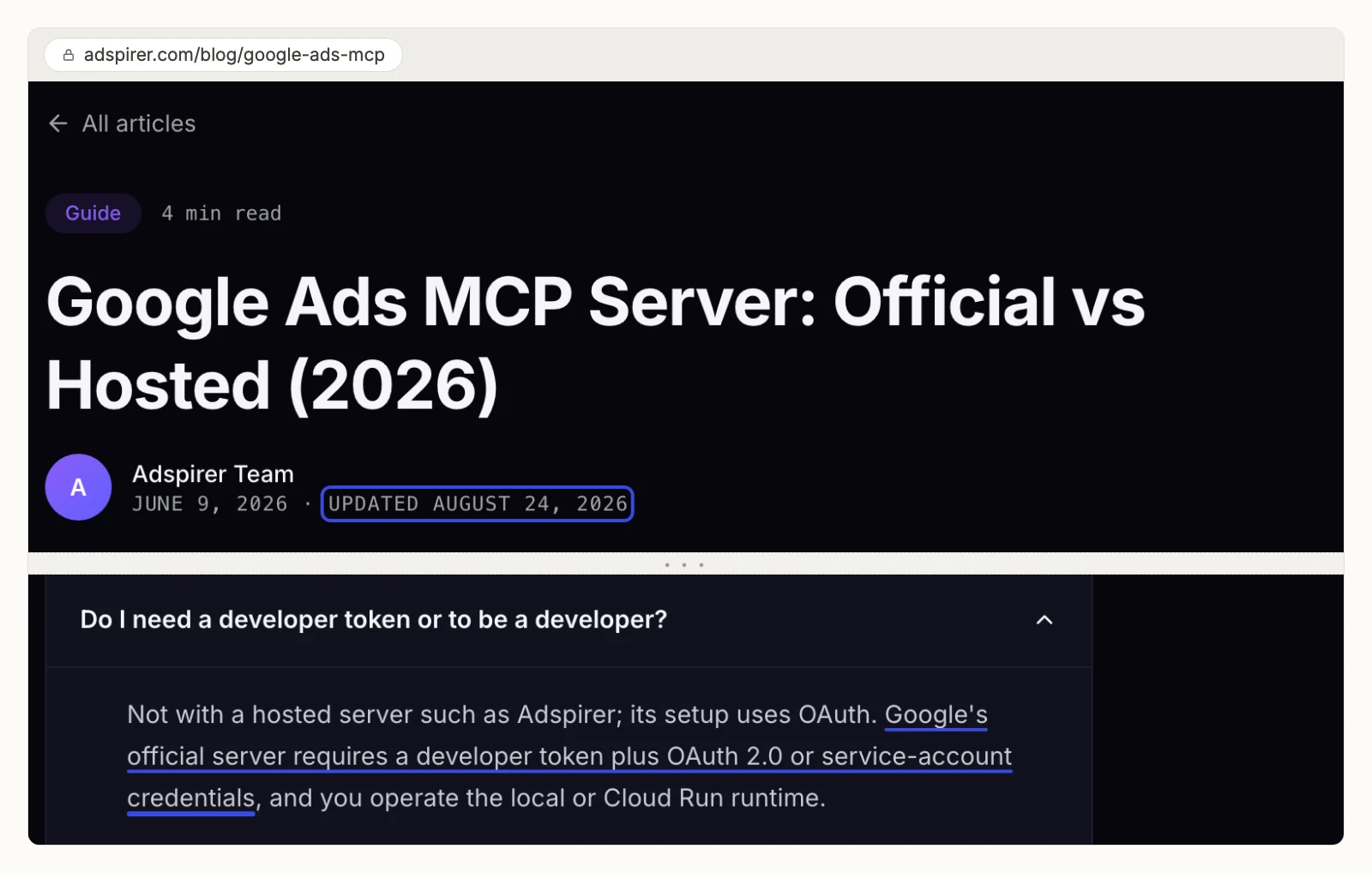
- Developer tokens: Adspirer's post (updated 2026-08-24), Scalekit's post, AdKit's roundup and NotFair's comparison still say Google's server needs a developer token. Google sunset tokens on September 9, 2026.
- Google: its guide, updated 2026-10-30, still says "Read-only (current release)"; its v0.0.6 release of 2026-11-02 adds asset and label writes.
- Synter: a "Free tier" with no card in its post, "card required" on its pricing page.
- Markifact: "Every change waits for your approval" on its product page; in its docs, that approval is a setting in your AI client.
- Adspirer: 15 "tool calls" in its post, 15 "tasks" on its pricing page.
- Pipeboard: no Keyword Planner tool in its API reference.
Frequently asked questions
Sources (checked 2026-11-02)
Every competitor claim above comes from that vendor's own page, documentation or repository, opened on 2026-11-02.
- InsightfulPipe: Google Ads MCP server, pricing
- Google: MCP server guide, repository, v0.0.6 release notes, developer token sunset
- Markifact: product, MCP docs, pricing
- AdKit: access levels, pricing, roundup
- Adspirer: official vs hosted, pricing
- Pipeboard: API reference, pricing
- Ryze AI: Google Ads MCP, pricing
- Synter: comparison post, pricing
- Composio: toolkit, docs, pricing
- Windsor.ai: write actions, pricing
- Scalekit: MCP vs API
- NotFair: comparison, pricing
- Opus Growth: Google Ads MCP
- Zapier: Google Ads MCP
- Adzviser: MCP
- Community: FGRibreau/mcp-google-ads, get-mcp-ads, clientskatbi, gomarble-ai, cohnen